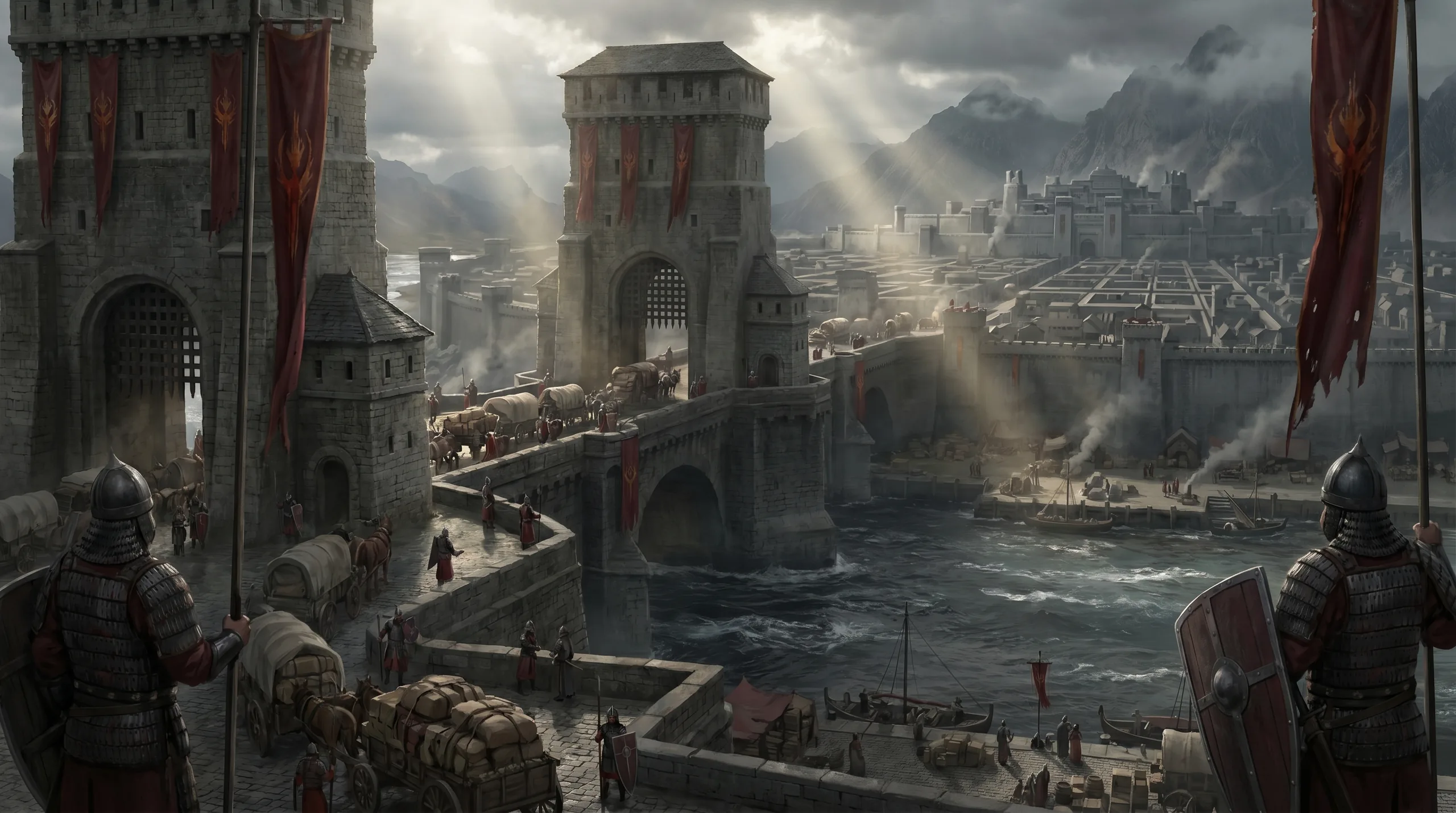
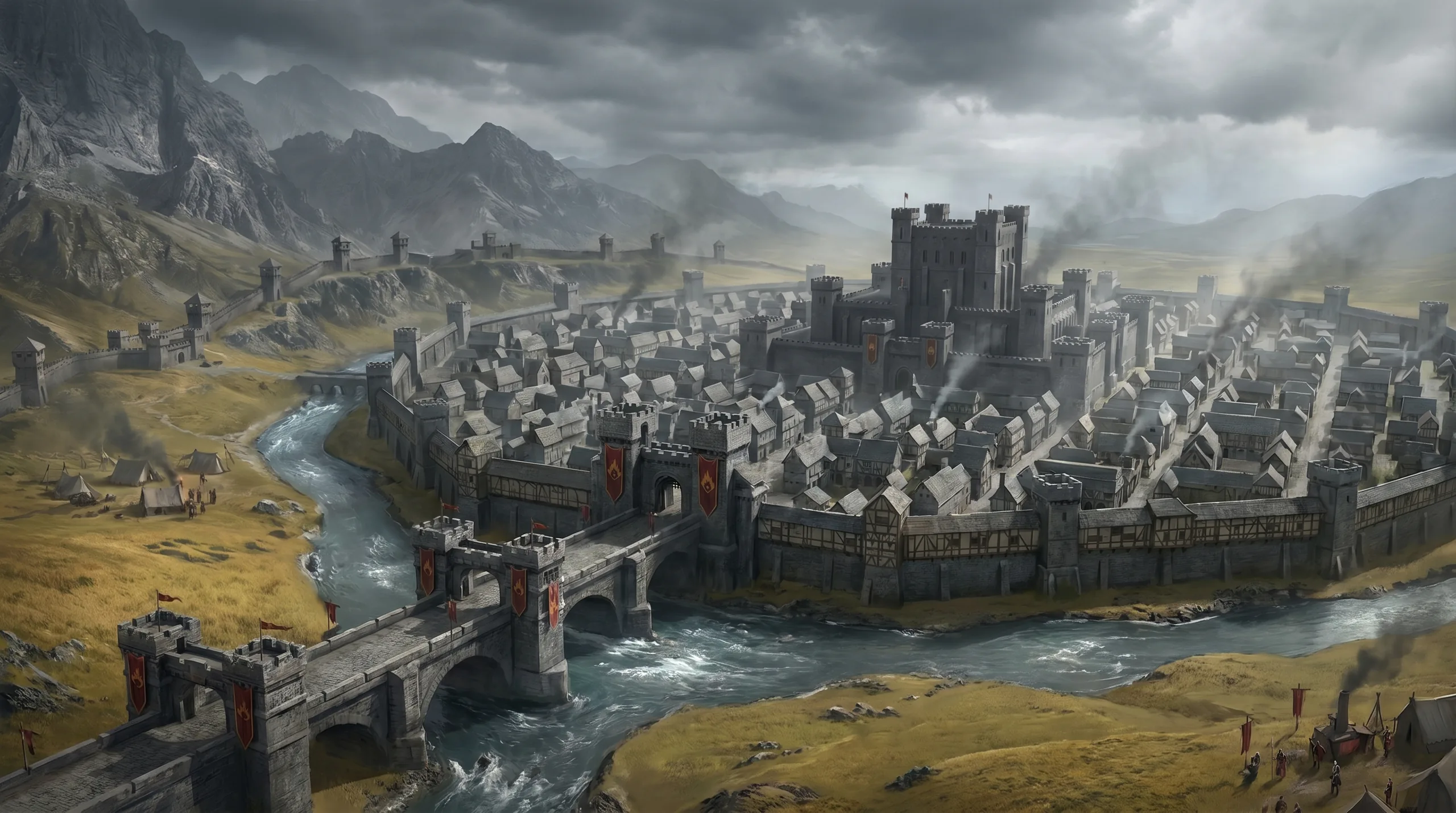
At the upper reaches of a great river, where the water is still strong but narrow enough to bridge and the hills funnel every road into a handful of mountain passes, stands the city that sells walls. Andronis began as a desperate wooden redoubt guarding a ford, and it has never stopped being a fortress — but its genius was to make the fortress portable. Its founder, Andronicus, cut off across the river and harried by beastmen, survived by building forts out of wagons and palisades and drilling everyone who could stand to fight from a wall; the settlement that grew where he finally won the far bank took his name and his doctrine both. Where the fortress walks, the Andronites say, and the bridge never sleeps.
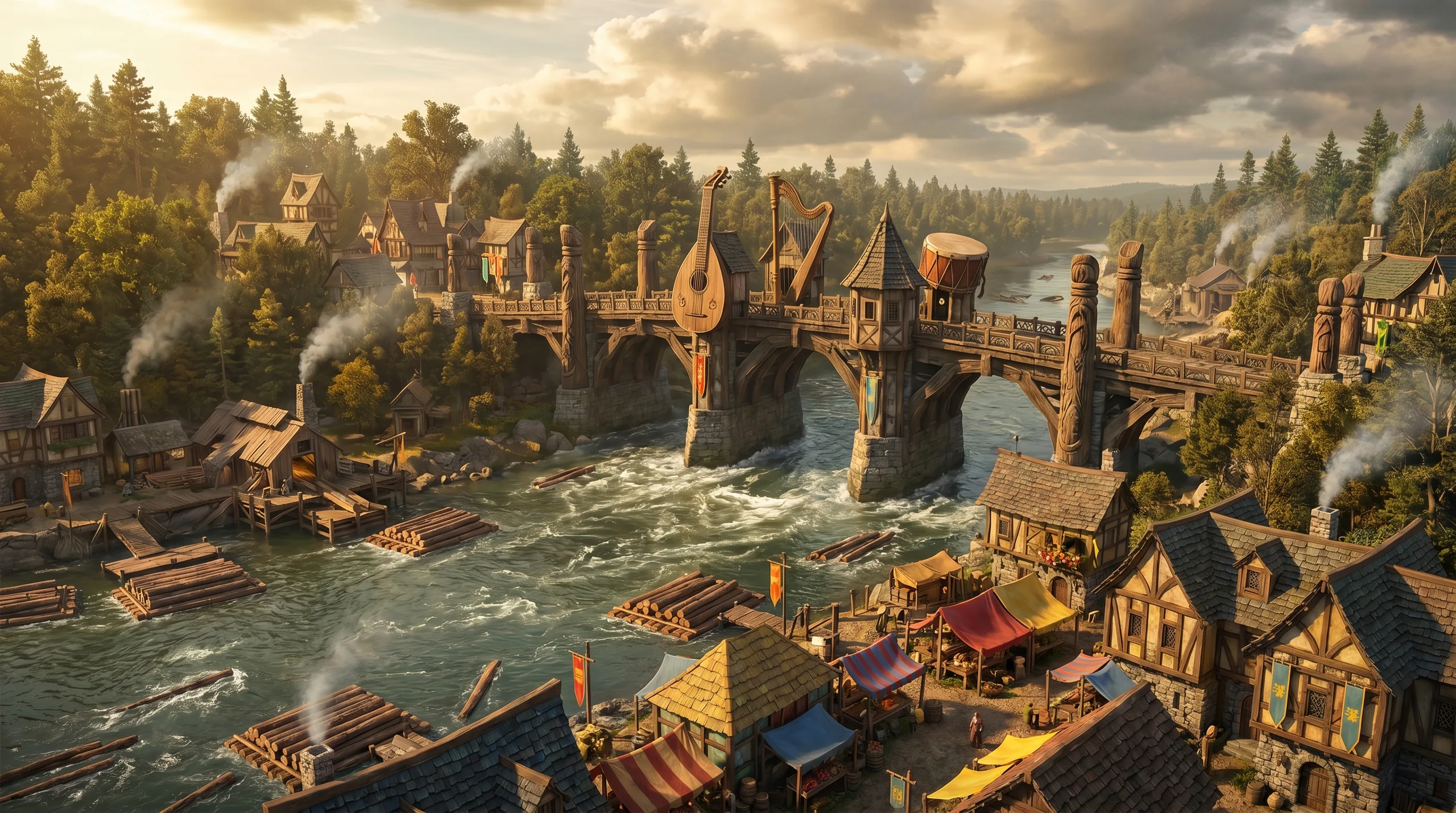
The city is laid out like one of its own camps: a strict street-grid around the central citadel and the compounds of the ruling Klerokoi, broad straight roads built for wagon-trains and the rapid movement of troops, and designated "fort squares" where prefabricated palisades can turn several blocks into a sealed redoubt at need. Its symbolic and economic heart is the Bridge of Andronicus — a massive stone span with fortified towers and tollhouses, the only reliable crossing for leagues — and for generations the tolls and tariffs of that bridge, taken from every north-south and east-west caravan, were the city's whole fortune. Hire Andronis, the saying goes, and you hire a living wall.
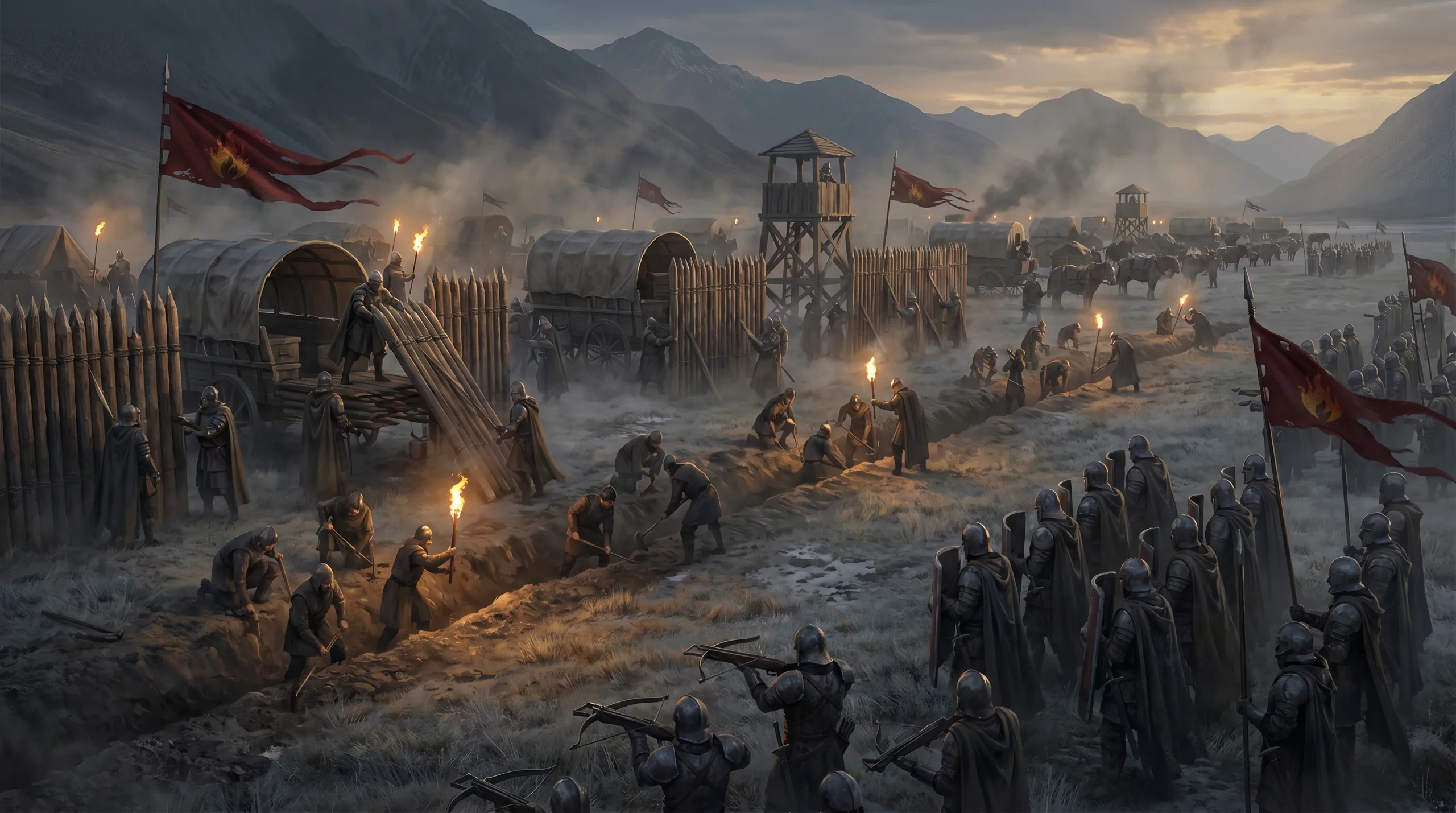
Andronis does not sell berserkers; it sells mobile fortress units, complete with doctrine, engineering, logistics, and command. An Andronite column carries a modular fortification kit — standardized palisade panels, gate-wagons that unfold into towers, templates for ditch and berm — and wherever it halts, a textbook fort rises by nightfall. Frontline shield-and-crossbow cohorts hold the line while fort-and-logistics cadres raise the walls; dropped into a city, they barricade chosen blocks and tie their works into existing walls and bridges until the place cannot be taken. We are not your cause, an Andronite will tell a client, flatly. We are your wall.
The Andronite ideal is not the lone hero but the well-fitted pair. Recruits train co-ed and are matched through long Shadow Pair trials that test compatibility in the field; the city promises every soldier a guaranteed spouse, on the theory that love can grow from proven habit. We do not pair hearts, they say. We pair habits. The hearts follow if they can. By the Law of the First Cradle no soldier may take a heavy foreign contract until married with a living child — and so the columns march as Forward Pairs, husband on the line and wife running camp and emergency defense, while Hearth Pairs hold the home watch. A man of Andronis, the proverb runs, is half a soldier without his wife.
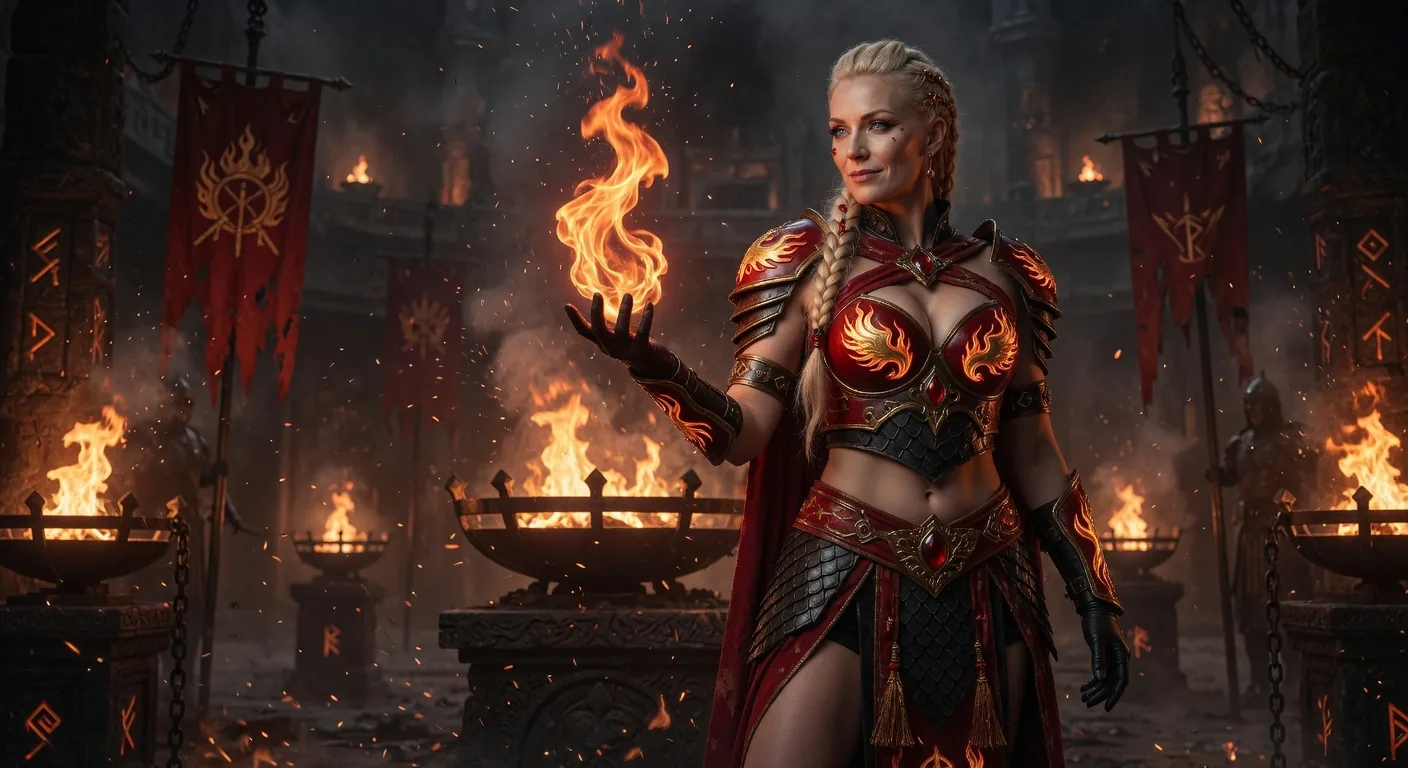
Andronis keeps the Ruby's war-aspect, the Firewife Pyranaika, with a strong ancestral inflection — Andronicus himself venerated almost as a saint, depicted standing on a half-built palisade with the river at his back. Real power, though, runs through the Fire Court: the walled compound of the Andros Klerokon, with its training halls, war-council chambers, and ritual braziers. The Andros line shares a dynastic thymara, so that any cousin's fire-magic sends a flare the others can feel — a minor casting a background hum, a desperate all-out burn a "storm" felt across the bloc.
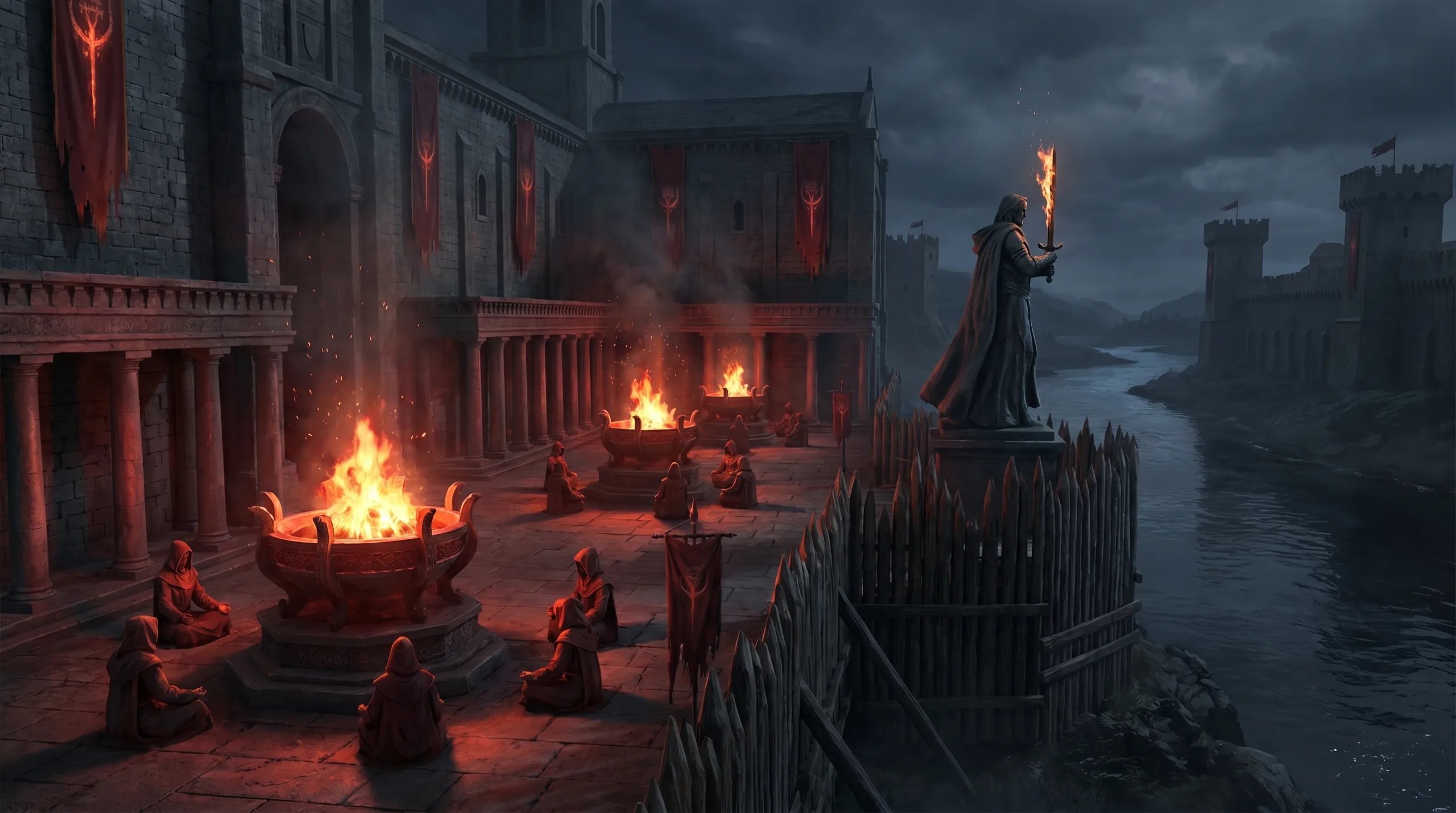
In their Flame Watches, Andros officers sit before the braziers and listen to that current, and high command often knows a battle has gone wrong long before any courier arrives.
 LoreThe Religion of the RubyThe Ruby is the most beloved and most feared of the gods of the human south — and of all the divine powers of Kworgale, she alone is worshipped not as a distant maker but as a…
 CityDrusmereThe Home of Song — a cheerful timber capital on a forest river, home to the continent's only College of Music and the joyful cult of Charakyra the Joymaiden, where dreamers and…
 RegionEastern KworgalyaTen wholly Suvanar settlements in the eastern rainforest, the only quarter of the continent where the Verdancy is charted alongside the Ruby and the Radiant Light.
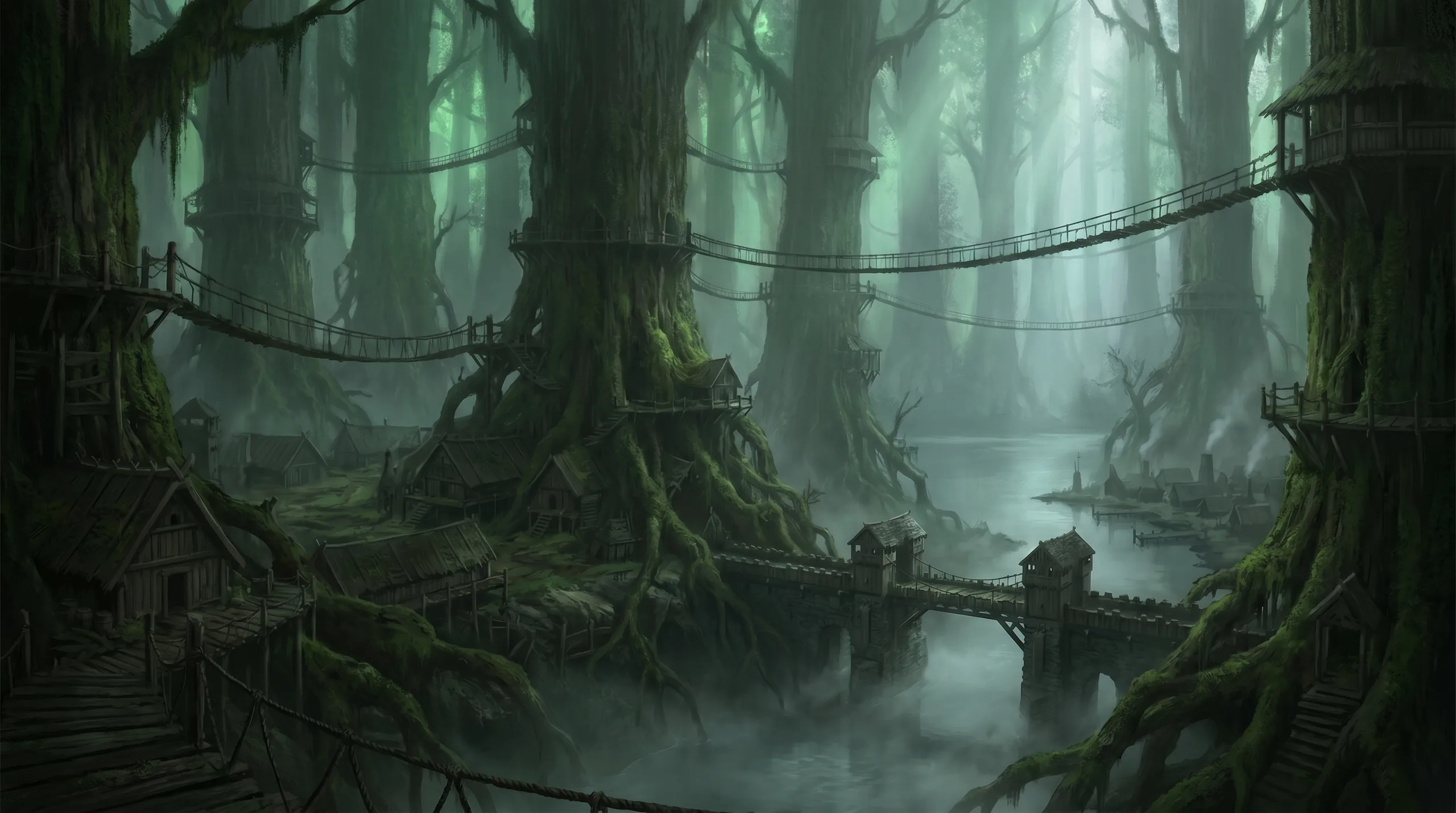 CityMorboraThe Shadowed City of Sunken Roots — a forest kill-zone of hunters, monster-takers, and the dynasty-trained assassins of House Borlov, a city that does not defend its walls so…
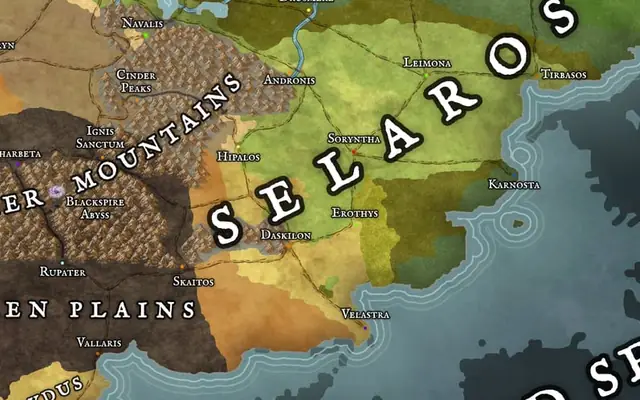 RegionSouth-Eastern KworgalyaTwelve settlements of savanna, grassland and rocky mountain in the continent's south-east, overwhelmingly Suvanar and overwhelmingly of the Ruby — the closest thing the Atlas…
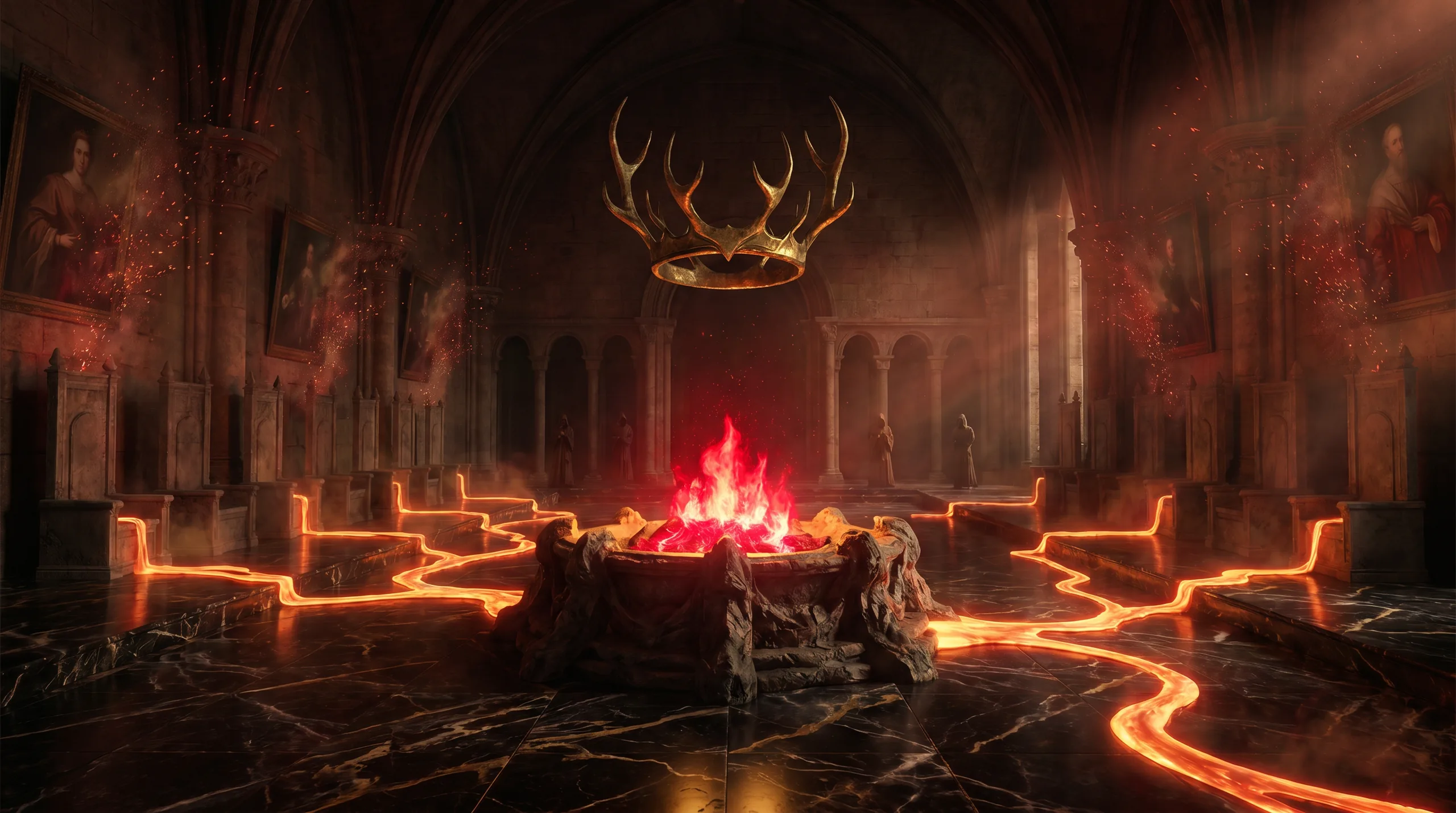 MagicKlerosia — The Kindred FlameThe Ruby's gift to her children was not power, but belonging. An officer of the Klerokon fire-corps looses the gathered flame of his bloodline. Klerosia is the magic of…
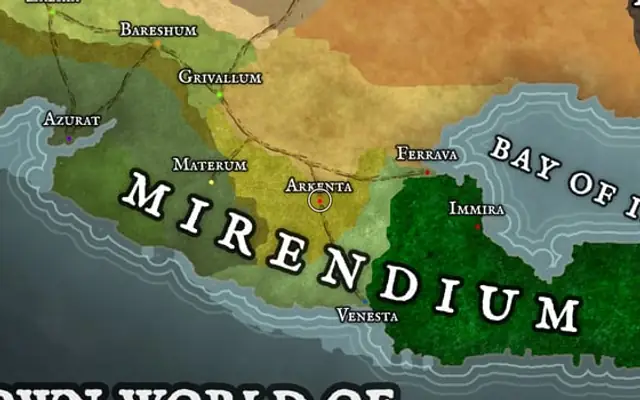 CityArkentaGreat, walled and mineral-rich in the southern shrubland, Arkenta heads the allegiance that carries its name, is governed from Venesta, and stands within the bloc gathered at…
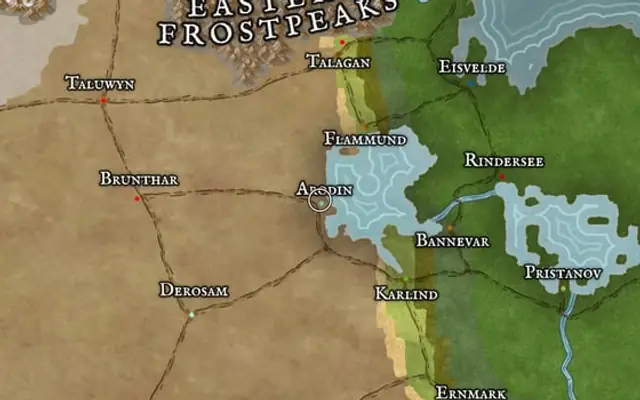 CityArodinThe grey wool-and-fish city on the great lake's desert shore — Caminor arms the Infernate; Arodin feeds and clothes it, and lifts lake-water into the desert's throat.